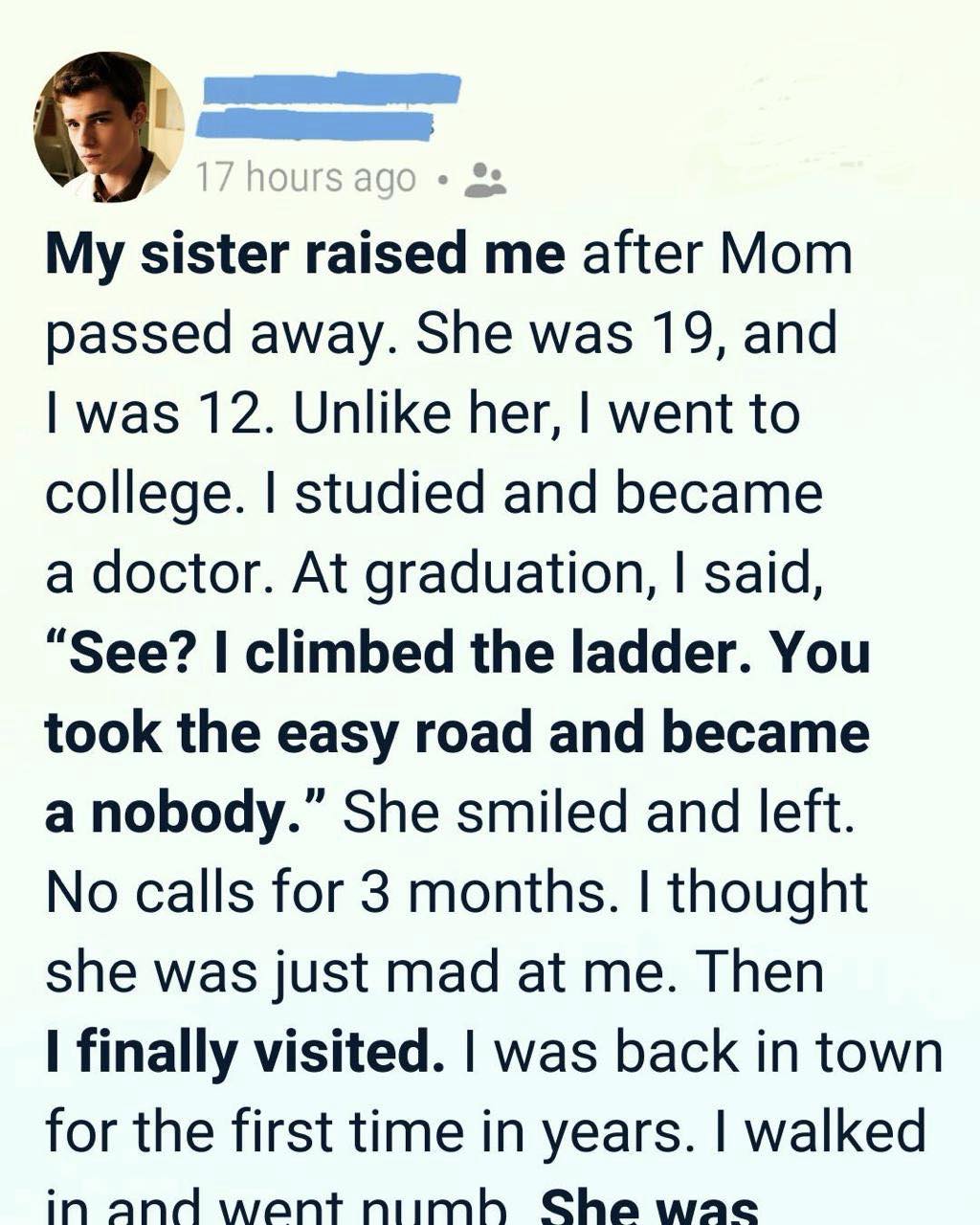
Claire didn’t argue. She didn’t cry. She gave me a small, tired smile—and walked away.
For three months, there was silence. No calls. No messages. I told myself she was angry, that she needed time. I buried myself in work, pretending success excused everything.
But guilt never stayed quiet.
Eventually, I went home.
The town felt smaller than I remembered. The sidewalks were cracked, the air heavy with memory. My chest tightened as I approached the modest house where Claire had raised me.
I opened the door expecting her voice—maybe anger, maybe relief.
There was only silence.
The living room was tidy, lavender lingering faintly in the air. I called her name. Nothing. Then I walked into her bedroom—and froze.
Claire lay in bed, frail and pale. Tubes and machines surrounded her, oxygen humming softly. My knees buckled.
She was gravely ill.
A neighbor stepped in behind me. “She didn’t want to worry you,” she said gently. “She’s been sick for months. She kept saying you’d worked too hard to be distracted.”
I moved to Claire’s side, heart pounding. Her eyes fluttered open. When she saw me, she smiled—the same gentle smile she’d worn at my graduation.
“I knew you’d come,” she whispered.
Tears blurred my vision. I gripped her hand. “I’m sorry,” I choked. “I was wrong. You’re not a nobody. You’re the reason I’m here. You gave me everything. You gave me your life.”
Her fingers squeezed mine weakly.
“You climbed the ladder,” she murmured. “That’s what I wanted. I didn’t take the easy road. I took your road—so you could walk it.”
The truth hit me all at once.
Claire had sacrificed her youth, her dreams, her health—everything—for me. And I had dismissed her as nothing.
I stayed by her side for days, listening to her stories, remembering nights she worked until dawn, mornings she packed my lunch with trembling hands. Every detail was proof of her strength, her love.
When she finally closed her eyes, her hand still in mine, the world collapsed again.
